
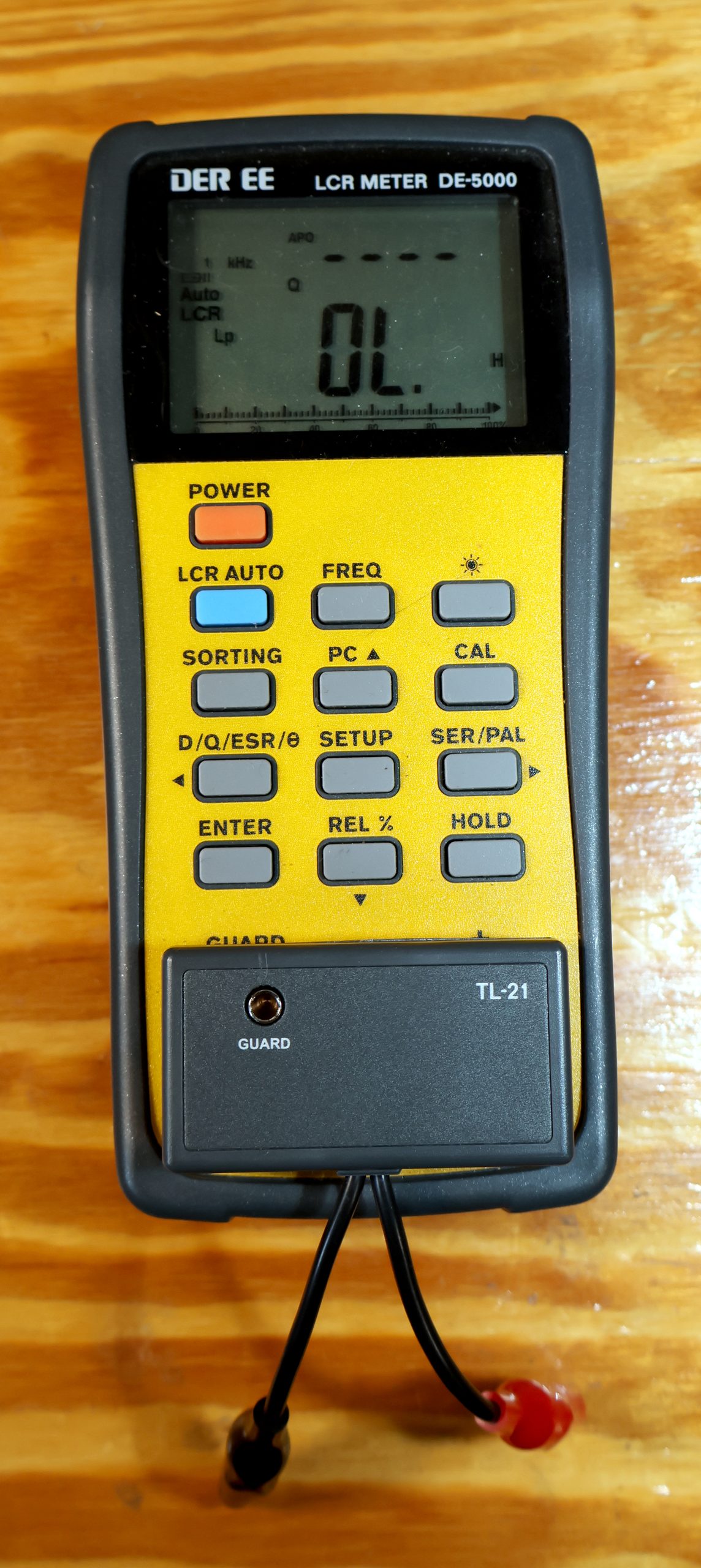
I bought the DE-5000 for one reason — I was tired of guessing. (And yes, half the internet calls it the “Deree ED-5000,” which is a bit like calling a Fender a “Fendar.” DER EE is the Taiwanese company, DE-5000 is the meter. Order one under either name and the same yellow-and-grey brick shows up.)
Before it arrived, my capacitor diagnosis workflow was basically archaeology: pull the cap, test it on a multimeter, discover the capacitance is fine, put it back, remain confused, drink coffee, repeat. Capacitance is the least interesting thing about an aging electrolytic. A 30-year-old cap in a mixer PSU will happily read 2200µF and still be the reason the whole console hums like a refrigerator. What has actually gone wrong is the electrolyte drying out, and that shows up as ESR — equivalent series resistance — not as lost capacitance.
Why ESR is the measurement that matters in audio gear
Audio equipment is unusually cruel to electrolytics. Power amps slam their rail capacitors with huge current peaks on every bass note. Switching supplies in modern gear run their output caps at high ripple frequencies until the electrolyte gives up. Vintage synths and tape decks have sat in garages for decades with no voltage on them at all, which is its own slow death. In every one of those cases, the failure signature is the same: ESR creeps up, the cap stops being a low-impedance path, and the symptoms show up as things that don’t look like a capacitor problem at all —
- Hum and buzz that changes with signal level
- Motorboating, or a low-frequency thump on power-up that never used to be there
- Bass that has gone soft and vague, with the amp clipping earlier than it should
- Intermittent digital sections that reset when the analog side draws current
- Supplies that measure a perfect DC voltage on a multimeter and are still full of ripple
A multimeter tells you none of that. The DE-5000 tells you in about four seconds. Set it to 100kHz, put it in Cs/ESR mode, touch the leads across the cap, and you get capacitance on the top display and ESR on the bottom, simultaneously.
The in-circuit thing: genuinely useful, genuinely limited
This is the part everyone wants to know about, so let’s be honest about it.
The DE-5000 can measure ESR on a cap that’s still soldered to the board, and it works often enough to be a real time-saver. On a recapping job with forty electrolytics, being able to sweep the board and flag the three suspicious ones instead of desoldering all forty is the difference between an evening and a weekend.
But it is a screening tool, not a verdict, and the reason is baked into the hardware. The DE-5000 applies a test signal of about 0.5Vrms. Dedicated ESR meters — the Blue ESR, the Capacitor Wizard — deliberately keep their test voltage well under the ~0.6V it takes to turn on a silicon junction, precisely so the surrounding circuit stays asleep during the measurement. The DE-5000 wasn’t designed with that constraint; it was designed to be an accurate LCR meter. So on a board, its test signal can partially wake up transistors and ICs sitting near your measurement point, and you’re no longer measuring one capacitor. You’re measuring one capacitor in parallel with whatever the rest of the board felt like contributing.
In practice this shakes out to a rule I’ve stopped violating:
- A bad in-circuit reading is meaningful. If you see 4Ω across a 1000µF cap, something is wrong there — pull it and confirm.
- A good in-circuit reading proves nothing. Low ESR could be your cap, or it could be three other caps on the same rail, or a low-value resistor, or a transformer winding cheerfully shorting your reading to near zero.
- Anything ambiguous gets one leg lifted. Thirty seconds with a desoldering pump beats an hour of arguing with yourself.
And the safety note, which I will put in capitals because I learned it the expensive way: DISCHARGE EVERYTHING FIRST. This meter has essentially zero tolerance for a charged capacitor. It is a precision instrument, not a fuse. Touching the probes to a filter cap still holding a few hundred volts in a tube amp is a very fast way to turn a nice LCR meter into a paperweight with a carry case. Bleed resistor, confirm with a DMM, then measure.
What it does beyond ESR, which is most of why I keep it
If it only did ESR I’d have bought a cheaper single-purpose meter. What justifies the DE-5000 on an audio bench is everything else it measures at five frequencies (100Hz, 120Hz, 1kHz, 10kHz, 100kHz):
- Crossover work. Measuring inductors properly, with their DCR, and matching film caps between two channels so the stereo image doesn’t drift.
- Transformers and chokes. Inductance at 100Hz and 1kHz plus DCR tells you a great deal about an output transformer before you commit to installing it.
- Matching and sorting. The tolerance sorting mode and relative mode make pairing components for filters and phase-sensitive stages almost pleasant.
- D and Q readings, which is often where a marginal film cap admits it’s marginal.
- SMD work, thanks to the included tweezers — one of the best accessories in the box.
Speaking of the box: it ships with alligator leads, SMD tweezers, a four-wire Kelvin/guard lead, and a hard case. Getting real Kelvin leads included at this price point is quietly remarkable — most manufacturers would have sold you those separately with a straight face.
The irritations
Nothing here is a dealbreaker, but they exist:
- The five-minute auto power-off. You will be mid-measurement, reaching for a probe, and the display will nap. It can be disabled, and you should disable it on day one.
- Open/short calibration is slow — roughly thirty seconds per step — and you need to redo it when you change leads. Do it once at the start of a session and stop resenting it.
- The PC/data-logging interface is optional and not included, which stings slightly given the meter is otherwise so complete.
- It runs on a 9V battery — around forty hours, which is fine, but 9V cells are the AA’s expensive cousin.
- The button layout takes a week to internalize. Auto mode is friendly; the good stuff lives in manual mode.
Final verdict
The DE-5000 is the a very useful piece of test gear per dollar on my bench. It brings genuine LCR-meter measurement quality — around 0.3% basic accuracy, five test frequencies, dual display — into a price bracket where you’d normally be choosing between a toy component tester and a single-trick ESR meter.
Just buy it with the right expectations. It is not a dedicated in-circuit ESR meter, and if your entire working life is speed-recapping switching supplies, a purpose-built ESR meter with a sub-junction test voltage will be faster and more trustworthy on the board. The DE-5000’s in-circuit ability is a convenience layered on top of an excellent bench meter — useful for triage, unreliable for acquittal, and completely fine once you understand which of those you’re doing.