
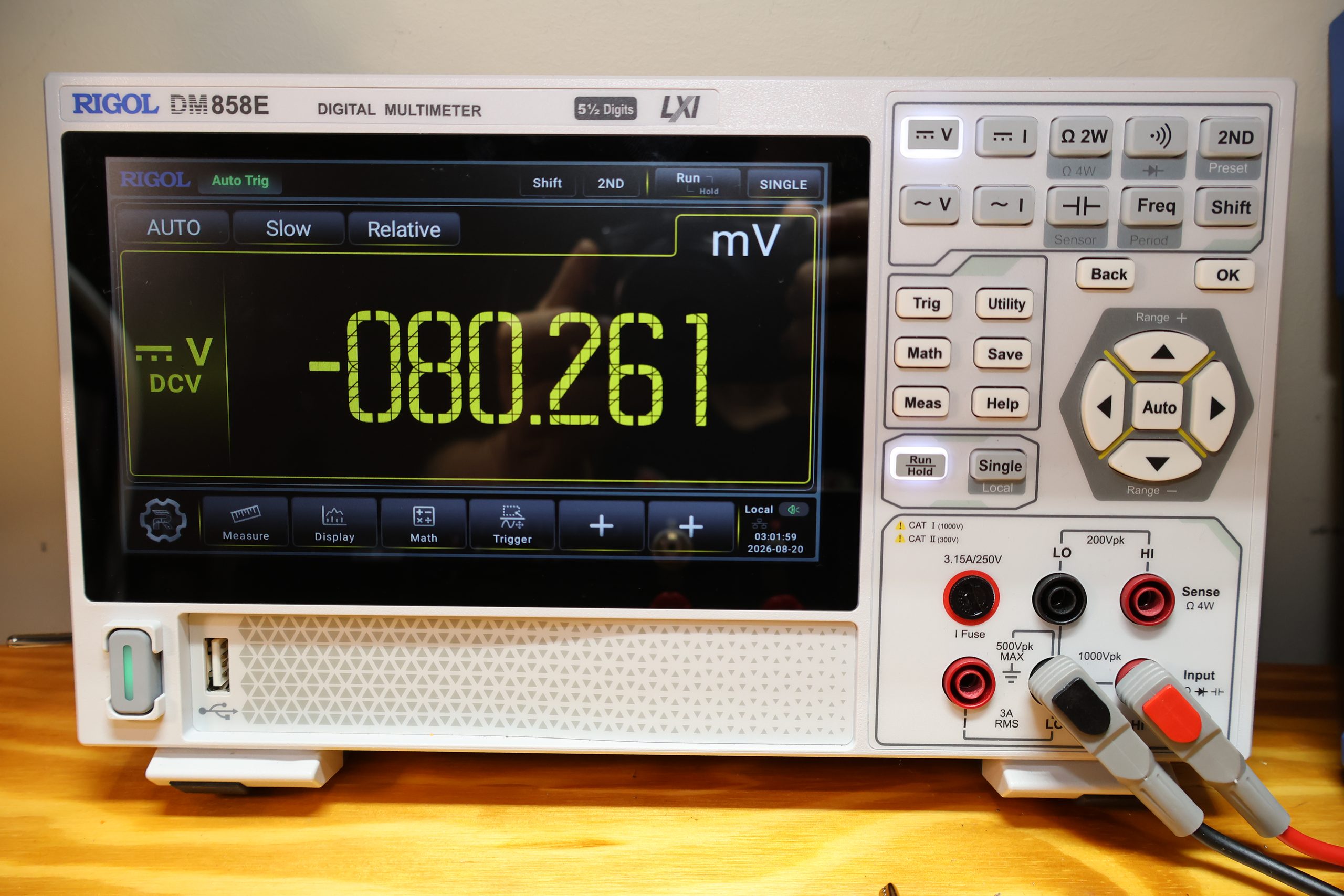
I bought the DM858E because my old handheld Triplet and I had reached the end of a long, codependent relationship. It was fine. It was also 3.5 digits, and every time I tried to match a pair of feedback resistors for a mic preamp it gave me three different answers and no apology and auto-ranging was very slow. So the Rigol landed on my bench, wedged between a console frame I’ve been “almost finished with” since spring and a coffee mug I’m no longer emotionally attached to.
First thing you notice is that it doesn’t look like a multimeter. It looks like somebody took one of Rigol’s scopes, put it on a diet, and told it to go be useful. It’s about 80 mm deep and 1.25 kg, so in bench-real-estate terms it’s a paperback, not a small microwave. There’s a VESA 100 mount on the back, so if your bench is as crowded as mine you can hang it next to the patchbay and stop pretending you’ll ever have room for it flat. The front is a 7-inch 1024×600 color touchscreen, and it’s the reason I stopped reaching for the old meter — big main readout, auxiliary field underneath, readable from across the room while you’re holding a probe in one hand and a chassis in the other.
How it actually works, and why that matters
Under the pretty screen it’s a 5½-digit instrument — 120,000 counts — with true RMS on AC. That count depth changes your day. Five and a half digits means when you’re checking 48 V phantom on a preamp rail, you’re not reading “48.0 and vibes” — you’re reading 48.012 and watching the last digit wobble in a way that tells you something about the regulator. DCV accuracy is specified at 0.06% over a year on the E, which isn’t metrology-lab territory and doesn’t pretend to be. For rail checks, bias setting, offset trimming and resistor matching, it’s comfortably better than the thing you’re measuring.
Like every good bench DMM it trades speed for quiet. Longer integration windows average out mains hum and give you rock-steady digits; shorter ones give you speed and a last digit that dances. The DM858E lets you pick your poison per function, and once you understand that dial it stops feeling twitchy and starts feeling honest. Autoranging is quick enough for general poking around, though I manually range anything I care about — a fixed range settles faster, and I like my numbers to sit still.
Speed
The E tops out around 80 readings per second with 20,000 points of internal memory. Be honest about what that buys you: this is not a transient capture tool, and if you need to catch a switching spike you want a scope, not a meter with opinions. What 80 rdgs/s does buy you is a trend chart that updates fast enough to be diagnostically useful. Watching the rail sag in real time while a power amp goes into a load is worth more to me than any number of static readings. Same with warming a tube amp from cold and watching bias creep across two minutes on the trend display, instead of squinting and writing numbers on the back of a spec sheet like it’s 1987.
Trend chart, histogram and bar chart are all built in. The histogram is the one I didn’t expect to use and now use constantly — if you’re matching parts, the shape of the distribution tells you more in three seconds than a column of numbers does in three minutes.
The spec sheet, abbreviated
- 5½ digits, 120,000 counts, true RMS AC
- 11 measurement functions: DCV, ACV, DCI, ACI, 2- and 4-wire resistance, capacitance, frequency, period, continuity, diode, temperature
- DCV 100 mV to 1000 V; ACV 100 mV to 750 V; current to 3 A; resistance to 50 MΩ; capacitance to 1 mF
- Thermocouple, RTD and thermistor support
- Math: statistics, limits, dB/dBm, relative
- USB host, USB device, LAN with web control, and full SCPI
- Powered over USB-C — it’ll happily run off a decent power bank for a working day
- CAT II 300 V
Two of those deserve a second look. dB/dBm math is right there in the menu — set your reference impedance, probe the output, read the number your paperwork actually wants. And 4-wire resistance matters more than people expect; measuring output transformer winding DCR at half an ohm with two-wire leads is really just measuring your own test leads and hoping.
LAN web control is the sleeper feature. Point a browser at it and you get the front panel on your laptop, so you can leave the meter clipped to something dangerous inside a chassis and read it from a safe, seated, coffee-adjacent distance.
The gripes
The big one, and the one nobody warns you about: it takes over a minute to boot. That’s not a typo. You push the button, the logo comes up, and you have time to go find the probe you set down somewhere, decide it’s gone forever, find it again, and come back — and it’s still thinking about it. My old handheld was ready before my thumb left the button. This one boots like a laptop because, functionally, it is one. Most of the time it doesn’t matter, since the meter lives on the bench and stays on. But the one time you’re over an open chassis with a client watching, waiting for a splash screen to finish having its moment, you’ll feel every second. Turn it on first, make coffee second.
After that, the 3 A current ceiling is the real compromise versus the non-E model’s 10 A, and it’ll bite you the first time you try to measure amplifier idle draw at the mains side. Don’t — that’s what a clamp is for. The 20,000-point memory is thin if you were dreaming of long unattended logging runs; this is a spot-check instrument that happens to graph, not a data logger. And CAT II 300 V means you keep it out of the mains panel, full stop.
Firmware-wise it’s the usual modern-instrument story: capable, occasionally quirky, worth checking for updates before you decide something is broken.
Final verdict
The DM858E is the meter I actually reach for, and that’s the only benchmark that ever matters. It gives up current range, sample rate and a little accuracy compared to its bigger sibling, and in exchange it costs meaningfully less and does 95% of what a repair bench needs. The screen is excellent, the graphing is genuinely useful rather than decorative, the dB math and 4-wire mode fit audio work exactly, and running it off a power bank makes it a field instrument by accident. It won’t calibrate your lab, it won’t survive your mains panel, and it will make you wait a full minute for the privilege of using it. It will, however, sit quietly on your wall, tell you the truth about your rails, and make you look competent in front of clients. Strong buy for anyone servicing audio gear. Just budget for a clamp meter to keep it company.