
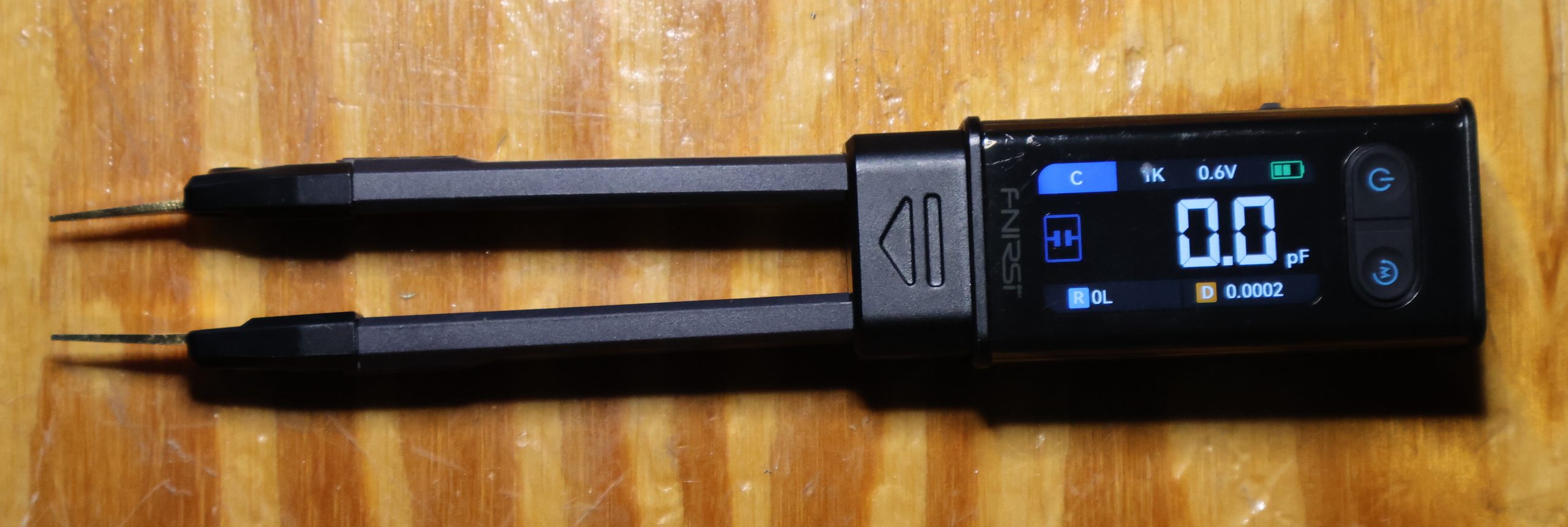
Short review, because the thing itself is short. I bought the LCR-ST2 expecting a toy and ended up keeping it in my apron pocket next to my good tweezers, which is the highest compliment I give any test gear.
Most of my work is audio — vintage receivers, mixing desks, pedals, the occasional amp somebody’s cat has opinions about. That means electrolytics, and electrolytics mean ESR. Being able to grab a cap right on the board, at 100 kHz, and see capacitance and ESR side by side without desoldering anything has quietly saved me hours. The 100 Hz and 120 Hz settings are there too, which matters when you’re checking big filter caps rather than tiny SMD ones.
What I actually like:
- It fits where my hands don’t. Between a transformer and a heatsink, under a ribbon cable, along the edge of a crowded PCB — the tweezer form factor gets in and out without a third hand.
- Auto-detect that works. Pinch a part, get R, L, or C. No dial, no mode hunting, no swearing.
- Matching pairs is painless. Left channel, right channel, done in ten seconds.
- Selectable test level. Low drive voltage means junctions stay asleep and readings stay honest.
- The magnet on the back. Silly little feature. I use it constantly.
- Swappable tips, including Kelvin clips, plus USB-C charging and a screen that flips for lefties.
Gripes: battery is good for a couple of hours, so it lives on the charger between jobs. The included pouch feels like it was designed by someone who has never owned a pouch. And it’s a fast, convenient meter, not a lab bridge — don’t take it to court.
Final verdict: for the money, this is the most useful thing on my bench that isn’t a soldering iron. If you repair audio gear, buy it and stop reading reviews.