
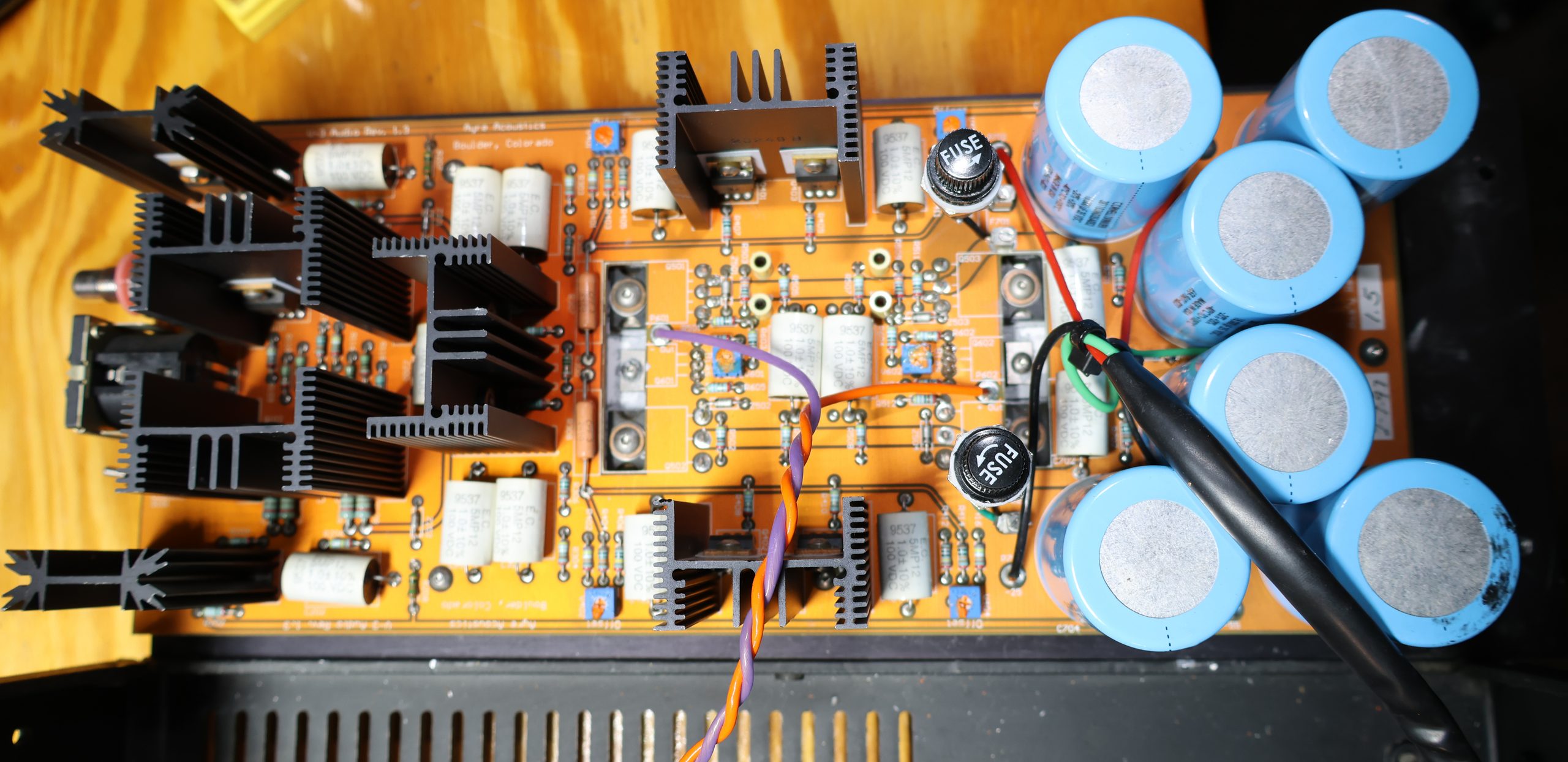
This is my second Ayre V-3 on the bench. The first one was easy — a cracked solder joint, reflow, done. This one was not.
The fault
The amp came in dead on one channel. Probing the output stage turned up two of the four output MOSFETs shorted. Normally that is a desolder-and-solder afternoon: pull the bad devices, drop in replacements, reset bias, ship it.
Except the V-3’s N-channel output device is an IRCP064, and the IRCP064 is unobtainium. Not “long lead time” unobtainium — gone. I reached out to Ayre to see whether they had any in stock. They didn’t, but they were genuinely helpful and sent me guidance on how the V-3 output stage is biased and how they sort and match transistors. That turned out to be worth far more than a bag of parts, so I’m summarizing it below.
The P-channel side, RFG60P06E, is still available, so that half was easy — I bought 10 and matched them.
What Ayre’s guidance say
1. Each channel is two “phases.” An input signal drives one speaker post positive while the other goes negative. Each of those halves — Ayre calls them phases — has its own complementary output pair, an N-channel and a P-channel MOSFET with their sources tied together.
2. One transistor sets the idle current for the whole pair. Between the two output gates sits a single IRF640 (Q601/Q602) acting as a bias spreader. It holds a nearly fixed voltage between those gates. That gate-to-gate voltage is what sets how much current the output pair idles at with no signal — the bias. In the V-3 that’s roughly 700 mA per phase.
3. MOSFETs get greedier as they get hot. A hot MOSFET needs less gate voltage to pass the same current, so at a fixed gate voltage it passes more current, which makes it hotter still. Left alone, that loop ends in a shorted device. This is thermal runaway, and it is almost certainly what killed the two transistors in this amp.
4. The spreader is the safety mechanism. The IRF640 spreader sits in the same thermal environment as the outputs. As it heats up, it conducts more, which reduces the gate-to-gate spread and pulls the output devices back. The spreader is the thing that stops the runaway.
Finding a replacement for the IRCP064
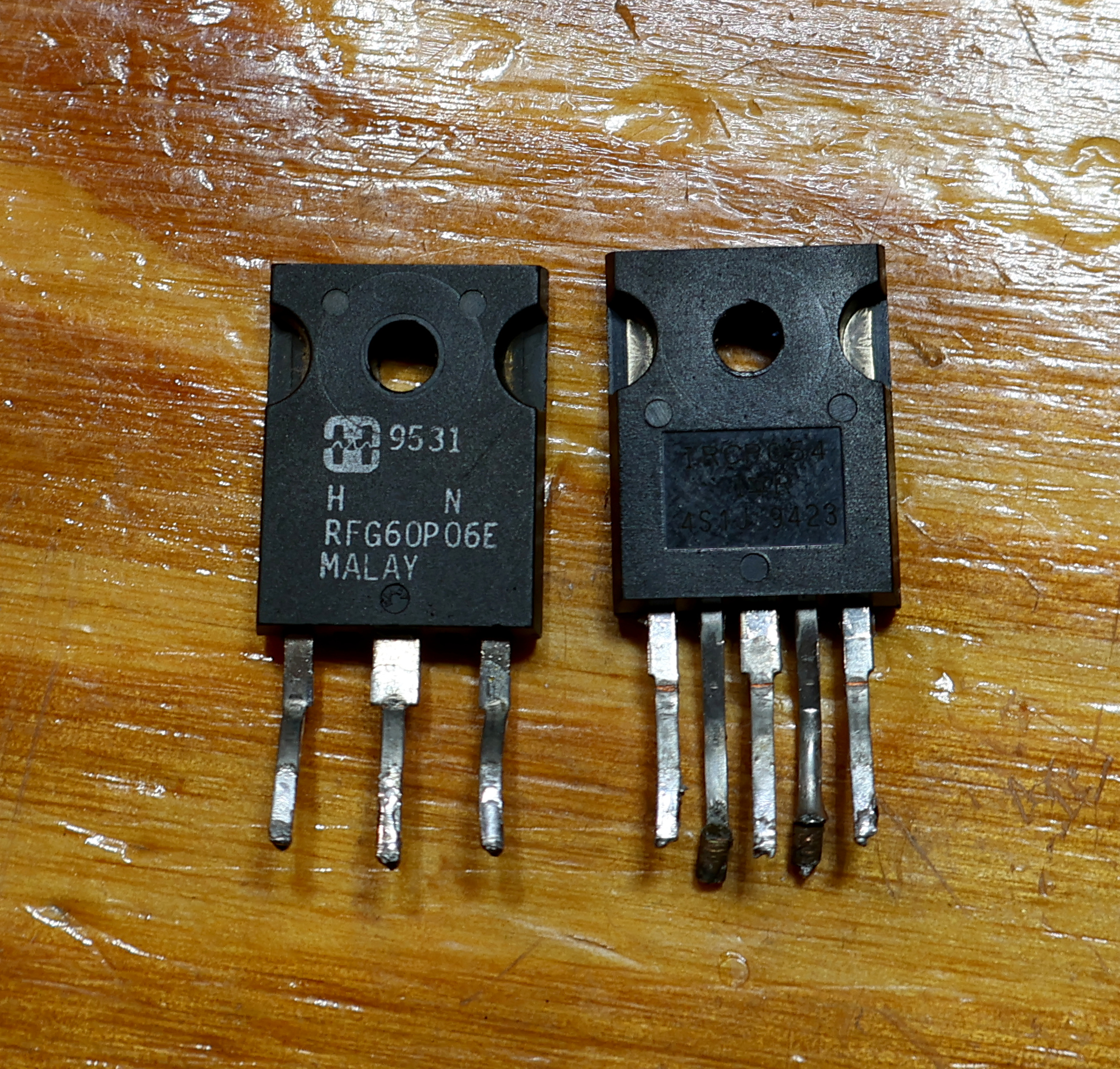
This is where I spent most of my head-scratching time. Nothing in the usual cross-reference tables is a drop-in.
Eventually I landed on the IRFP064. Same die, same electrical specs — same voltage, same current, same on-resistance. The difference is the package pinout: the IRCP064 is a current-sensing device with five legs, where two extra pins bring out a mirror of the drain current. The IRFP064 is the plain three-leg version.
For a while I assumed that killed it. It doesn’t, because the V-3’s bias can be set by monitoring current at the fuse terminals directly — you don’t need the sense leg to get an accurate reading of what the output pair is drawing. Once I convinced myself of that, the substitution became reasonable: the part that matters for a safe, stable output stage is the device characteristics and the matching, and those carry over intact.
So: 10 IRFP064 and 10 RFG60P06E on the bench.
Matching
Out of each batch of 10 I picked the two closest based on Vgs Threshold and Gm.
Setting it up
Bias and DC offset deserve their own write-up, so I’ll keep this short: the two interact, they have to be walked in together over several passes, and the first power-up is done carefully with current monitored, because a mismatched set announces itself immediately by climbing rather than settling.
It worked. Offset and bias both came in and held.
Verification
The important test isn’t “does it make sound,” it’s “does it make the same sound as the channel I didn’t touch.” I put the amp on the spectrum analyzer and measured power, distortion, and noise on both channels.
Everything came in to spec — and, more to the point, the rebuilt channel measured the same as the untouched one. That’s the result I was after. Two substituted part numbers, a matched set, and a channel that’s indistinguishable from the factory one.
I’ll call that a success.
Thanks to the folks at Ayre Acoustics, who had no obligation to help a third-party tech with a 20-year-old amplifier and did anyway. The technical notes summarized above are theirs; any errors in the simplification are mine.