
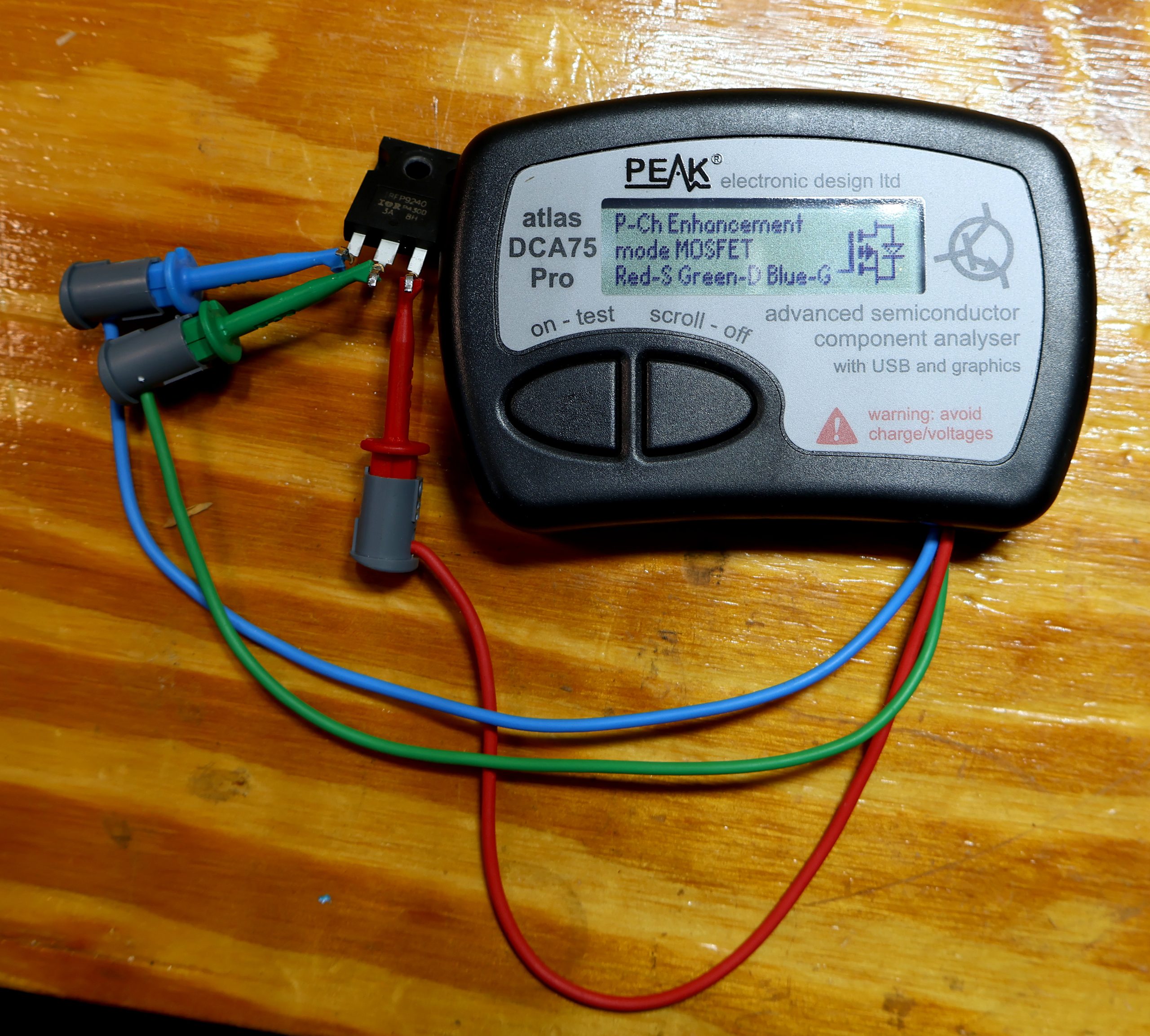
I bought my DCA75 Pro because I got tired of being wrong. Not spectacularly wrong — just quietly, expensively wrong, in the way that ends with a channel that runs hotter than its twin and a customer who says “it sounds fine, but…” three weeks later. That’s the photo above: my unit, scuffed lid, leads permanently tangled, sitting on the bench with an IRFP9240 clipped into it. Red on source, green on drain, blue on gate, and the screen calmly announcing P-Ch Enhancement mode MOSFET before I’d even found my reading glasses. That moment is basically the whole product pitch.
What it actually does
Three leads. Two buttons. You clip it onto any three-legged mystery and press the left button. It figures out what the part is, which leg is which, and then tells you a genuinely useful amount about it. No lead order to remember, no “is this EBC or ECB or the Japanese one that’s backwards,” no squinting at a datasheet PDF at 11pm.
Here’s what lives on my screen most evenings:
- Bipolars — pinout, hFE, base-emitter voltage, leakage, and whether there’s a hidden base-emitter resistor or a built-in protection diode lurking in there.
- Darlingtons and digital/BRT transistors — it spots the internal resistor network instead of reporting nonsense gain, which is more than I can say for the hFE socket on a bench DMM.
- MOSFETs and IGBTs — channel type, pinout, gate threshold voltage, and forward transconductance.
- JFETs — including the depletion-mode ones that make cheap testers throw a tantrum.
- Diodes, LEDs, diode networks, voltage regulators, thyristors and triacs, with real forward voltages rather than a beep.
And then there’s the USB side, which is the part I underrated when I bought it. Plug it into a PC and you get actual curve tracing — output characteristics, transfer curves, diode I/V plots. It’s not a Tektronix 576, and it won’t melt anything for you, but seeing a family of curves instead of a single number changes how you think about a part.
Why this matters specifically for audio
Because audio amplifiers are the one place where “close enough” turns into heat, distortion and DC offset.
Take a complementary output stage. You’ve got a bag of output devices — maybe a matched pair from a reputable supplier, maybe four transistors of unknown provenance you pulled from a dead Marantz because nobody makes them anymore. If those devices don’t share their characteristics, the pair that happens to have a bit more gain hogs the current. It runs hotter. Running hotter shifts its bias further. Congratulations, you’ve built a slow-motion thermal runaway with a warranty attached.
For BJTs, I sort on two things: hFE and Vbe. Gain matching keeps the halves of a push-pull stage doing equal work. Vbe matching is the one that matters even more in the small-signal end of the amp — the long-tailed pair at the input. A few millivolts of Vbe mismatch between the two devices in a differential pair walks straight through the amplifier as DC offset and shows up as second-harmonic distortion that no amount of feedback fully cleans up. The DCA75 lets me clip through a tray of 2SA/2SC parts, write the numbers on a bit of masking tape, and pick the two that agree.
For MOSFETs, it’s Vgs(th) and gm. Threshold voltage is the big one. Two devices from the same reel can differ by a volt or more in gate threshold — that’s not a defect, that’s just how vertical MOSFETs come out of the fab. Put a low-threshold and a high-threshold device in parallel and the low one turns on first, takes more current, gets hotter, and — because vertical MOSFETs have a positive tempco down at low bias currents where audio output stages actually live — takes even more. So much for “MOSFETs self-balance.” That’s true up at 10 amps. Down at the 100mA idle current of a nicely biased class-AB stage, it’s the opposite, and the tester is what stops you finding out the hard way.
Transconductance matching does the other half of the job: it’s what keeps the positive and negative halves of the waveform behaving symmetrically through the crossover region, which is exactly where the ear is least forgiving. Matching gm between the N-channel and P-channel sides of a complementary MOSFET output stage is never perfect — the physics won’t allow it — but you can pick the pair that’s least awful, and that’s a real, audible improvement.
The other thing the DCA75 does for me, which I didn’t anticipate, is catch fakes. The market for obsolete audio semiconductors is, let’s say, enthusiastically supplied. If I order ten “2SK1058” and the tester reports a threshold and transconductance that look nothing like a lateral MOSFET, or reports six identical parts with suspiciously identical numbers to three decimal places, I’ve learned something before it’s soldered into a customer’s amplifier. Restamped parts are extremely convincing under a magnifier and not convincing at all under a curve trace.
The honest limitations
It is a low-power instrument. It tests in the milliamp region, not the amp region. That means hFE reported by the DCA75 is hFE at a small test current — useful for sorting and comparing, but it is not the gain your output device will show at two amps and 60°C. Same story with threshold: it’s measured at a defined small drain current, so it’s a superb relative sorting tool and only a rough absolute one. If you need matching at real operating conditions, you still need a proper jig with a heatsink and a bench supply. What the DCA75 gives you is the fast first pass that gets you from forty candidates down to the six worth putting on the hot jig.
It also won’t test breakdown voltage, it won’t test in-circuit with any reliability, and it will happily be confused by a part still soldered next to a low-value resistor. And the supplied leads are, charitably, “adequate” — mine live in a permanent tangle that suggests they’ve given up on ever being coiled properly again.
Final verdict
The DCA75 Pro is the least glamorous thing on my bench. It doesn’t do anything a scope, a curve tracer and a lot of patience couldn’t do — it just does it in four seconds, with three clips, one-handed, while I’m holding a soldering iron in the other hand. For anyone repairing or building audio gear, where matched devices are the difference between an amplifier that idles happily for twenty years and one that cooks its own outputs, it pays for itself the first time it stops you from installing a mismatched pair.
Buy it if you work on amplifiers, sort through salvaged or grey-market semiconductors, or have ever squinted at an unmarked TO-220 wondering which leg is which. Skip it if you only ever fit brand-new, factory-matched parts from a distributor you trust completely — and if that’s you, I’d like to know your supplier.