
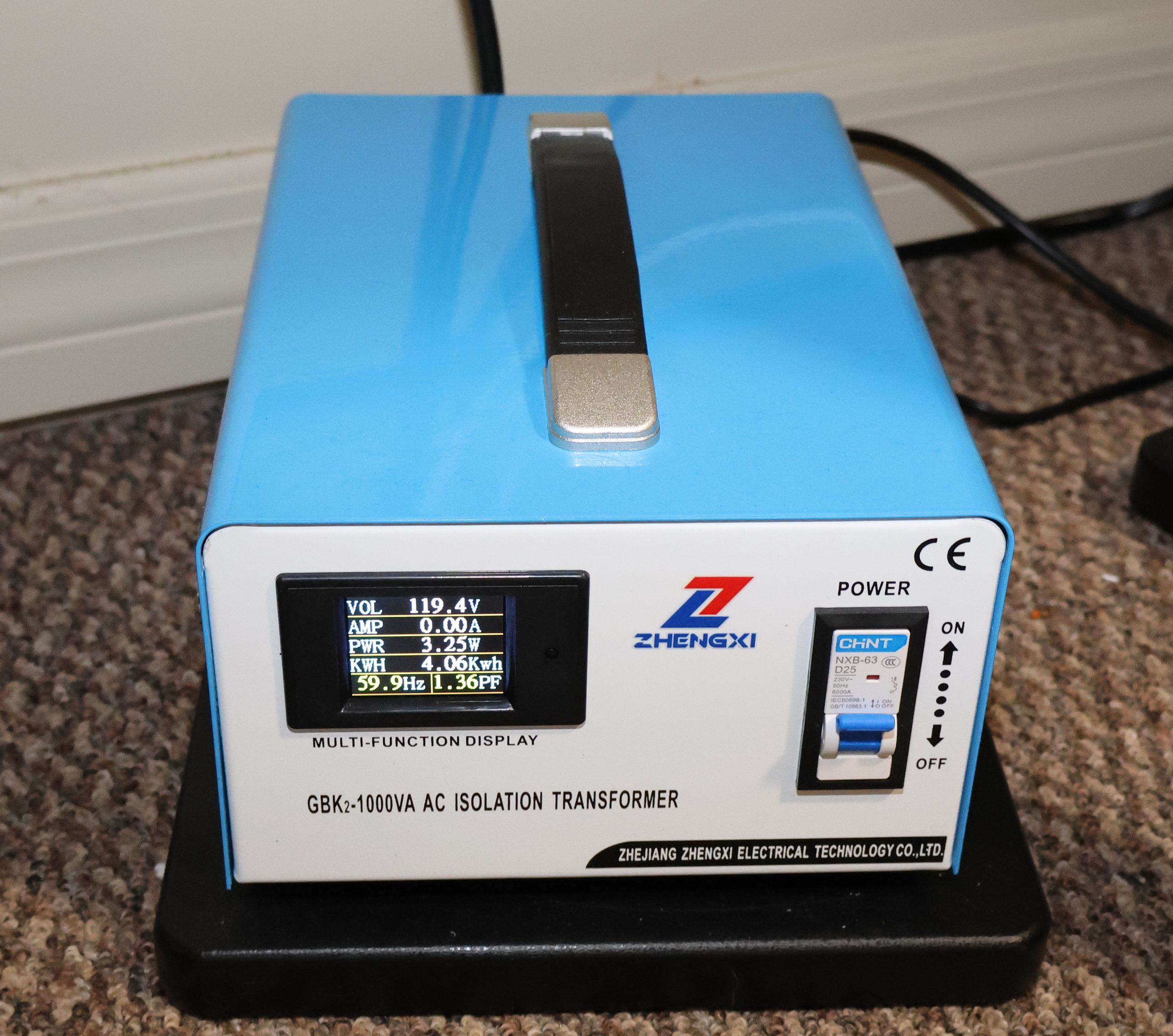
That blue and white box in the photo is a Zhengxi GBK2-1000VA AC isolation transformer, and it has quietly become the most important thing on my bench (well, technically under my bench) that isn’t a soldering iron. It sits on its little black base, hums to itself, and does exactly one job: it refuses to let the wall outlet and my repair victim share a ground. For anyone who pokes around inside audio gear, that refusal is worth every penny.
The reason I bought it is embarrassing. I was working on a mid-century tube amp, one of those charming designs where the chassis itself is one leg of the mains. I clipped my scope ground to it the way I’ve done a thousand times, and the room briefly got very bright and very loud. The probe lead is still on my bench somewhere, wearing a black stripe where the insulation used to be. The scope survived. My dignity did not.
Here’s the part that took me too long to internalize: your outlet’s neutral is bonded to earth back at the panel, and everything metal in your shop — the scope case, the bench vise, the radiator, you — is connected to that same earth. So when a device under test has a live chassis, a leaky Y-cap, or a switching supply floating at half the line voltage, your body is a perfectly good path from that chassis to ground. Physics doesn’t care about your intentions or your years of experience.
An isolation transformer breaks that path. The secondary has no reference to earth at all, so neither of its legs is “hot” relative to your bench or your body. Touch one and nothing happens. That’s the whole trick, and it’s what makes the following possible:
- Clipping a grounded oscilloscope probe onto a live-chassis amp without redecorating the room
- Working on vintage AC/DC receivers and hot-chassis gear that predate the concept of a safety ground
- Servicing switch-mode supplies in modern powered speakers and class-D amps without floating the scope, which is the dangerous workaround everyone eventually regrets
- Killing the ground loop that makes every preamp on the bench hum like it’s possessed
- Being considerably less likely to become the most interesting item in the shop’s incident report
That last point is not entirely a joke. Line voltage doesn’t need much to stop a heart, and audio repair is a hobby where you routinely reach past 400V rails with a screwdriver and a hopeful expression.
So how’s the actual box? Better than the price suggests, and cheerfully weird in a few places. It’s heavy the way transformers are heavy, with a real steel case, a proper carry handle, and a base that keeps it from wandering. Mine hums a little — a low core buzz you notice in a silent room and forget the moment anything else is playing. If you’re doing critical listening nearby, put it on a mat or on the floor.
The 1000VA rating is the sweet spot for audio work. Every preamp, phono stage, tuner, tape deck, and integrated amp I’ve put on it has been a non-event. Moderate power amps are fine at normal test levels. Where you’ll find the edge is a big class AB monster driven hard into a dummy load — the transformer sags and the amp starts acting like it has a weak power supply, which it does. That’s not a defect, that’s arithmetic. If you regularly run 200 watt-per-channel behemoths at full song, size up.
The multi-function display on the front is the sleeper feature. It shows volts, amps, watts, accumulated kWh, line frequency, and power factor. I expected it to be a gimmick and instead I use it constantly. Idle current draw is one of the fastest diagnostic reads there is: a receiver that should sip 20 watts at idle and is pulling 90 has a shorted output transistor or a bias circuit that’s run away, and I know that before I’ve even taken the cover off. Watching wattage while a repaired amp warms up tells me whether the bias is settling or climbing toward a smoke event. The kWh counter is useless to me, and I love it anyway.
The display also provides comedy. Mine reports a power factor of 1.36, a number that cannot exist, since PF tops out at 1.0. Treat the volts and watts as trustworthy working figures and the PF reading as a small motivational message from the factory. In the same spirit, the front panel breaker is a CHNT NXB-63 D25 marked 230V 50Hz while the display beside it reads 119.4V at 59.9Hz. It works fine, and the D curve is the right choice — it tolerates transformer inrush without nuisance-tripping. Just don’t expect a 25A breaker to protect anything downstream. It’s a main disconnect, not a fuse for your patient.
Which brings me to the thing people get wrong: an isolation transformer is not a variac, and it is not a safety blanket. It doesn’t limit current, doesn’t ramp voltage, and doesn’t stop you from getting across both secondary legs at once. Grab both, and you’ll get the full experience with no interruption from the panel breaker, because there’s no ground fault to detect. It also stops isolating the instant you bond the secondary to earth — exactly what happens when you plug both the amp and the scope into its output and join them through a probe ground. Isolate the device under test, leave test gear on the wall, keep one hand in your pocket, and discharge your filter caps like a grown-up.
Paired with a variac and a dim bulb tester, it completes the trio that turns “power it up and see what happens” from a gamble into a procedure.
Final verdict: for audio repair, this is one of the highest-value purchases on the entire bench. It’s solidly built, the 1000VA rating covers the overwhelming majority of hi-fi work, the metering earns its keep as a diagnostic tool, and the isolation does exactly what it’s supposed to — silently, every time. The quirks are cosmetic: a fanciful power factor readout, mismatched component labeling, and a hum you’ll stop hearing in a week. Highly recommended, with the caveat that no transformer makes carelessness safe. Buy one, respect the fact that mains voltage still doesn’t like you, and enjoy the novelty of grounding your scope probe without flinching.