
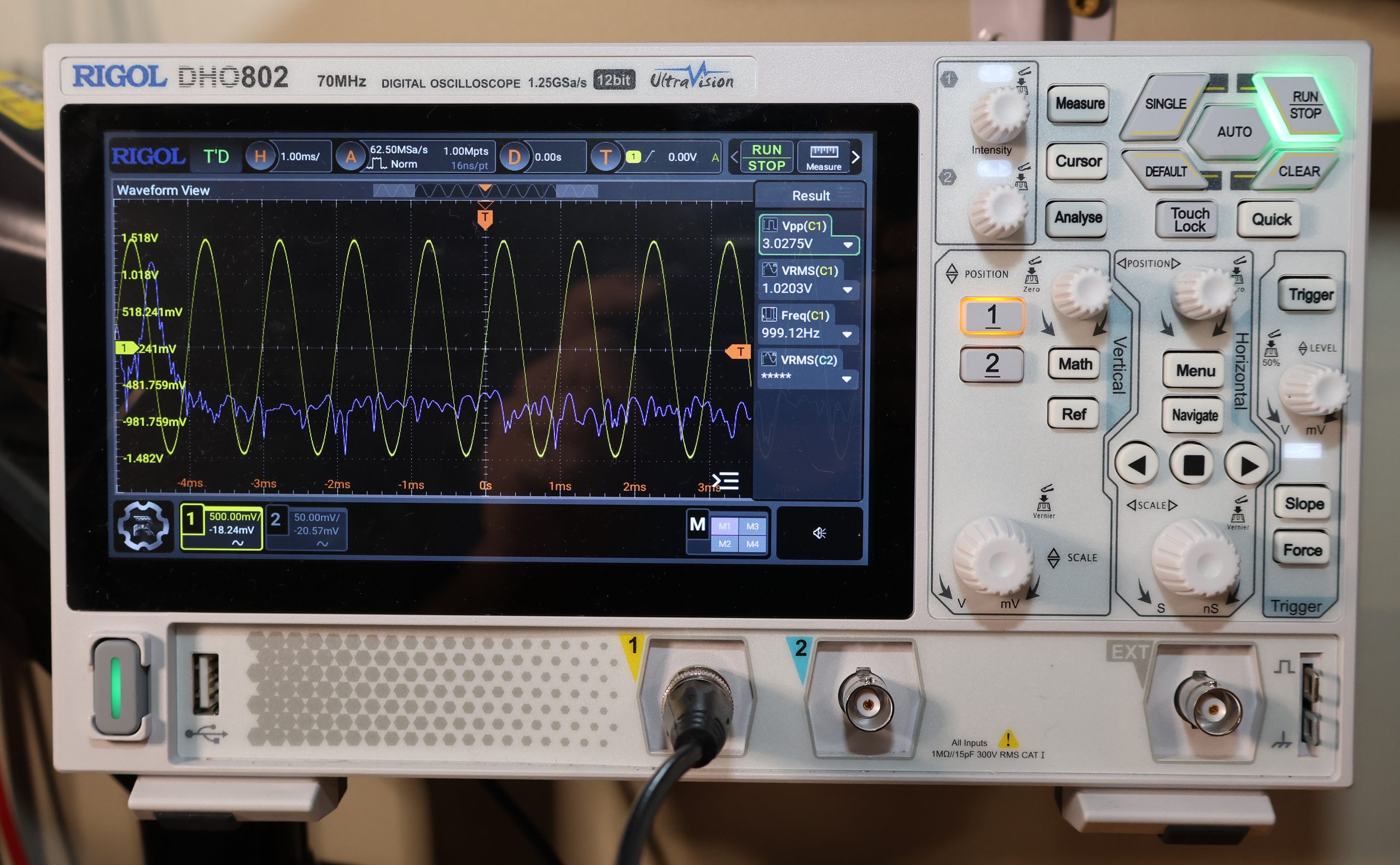
Rigol DHO802: the little 12-bit scope that quietly took over my repair bench
I did not need another oscilloscope. I want that on the record. I had a perfectly serviceable 8-bit box that had been staring at amplifier guts since before some of my customers were born. Then I put a DHO802 next to it, pulled up a 1 kHz sine at 5 mV/div, and had the specific embarrassment of realizing that half of what I had spent years calling “noise” was my old scope’s quantizer having a bad day.
What’s going on inside
The headline is the vertical resolution: 12 bits instead of the usual 8. That is 4096 quantization steps instead of 256, and once you have lived with it, going back feels like reading a book through a screen door. But the number alone is not the story — the topology behind it is.
Signal comes in at 1 MΩ, hits a relay-switched attenuator, then a variable-gain amplifier that scales the waveform to fill the ADC’s input window before digitization. That last part is the whole trick. On an 8-bit scope, a signal occupying a fraction of the screen throws away code levels you cannot get back. Here you have sixteen times the levels to burn, so a small ripple riding on a large DC offset still lands with real detail instead of turning into a staircase.
Behind the ADC sits Rigol’s own acquisition silicon, and that is where the sample-rate math starts to make sense. You get 1.25 GSa/s with one channel running; turn on the second and it halves to 625 MSa/s, because the converter resources are shared, not duplicated. Memory does the same dance: 25 Mpts single-channel, 10 Mpts with both. Nobody advertises the halving in bold type, but at audio frequencies you will never notice.
Then there is high-resolution mode, which oversamples and applies a decimation filter, trading bandwidth you were not using anyway for extra effective bits. On audio work, where 20 kHz is the ceiling and the front end is loafing at a fraction of its 70 MHz capability, this is free money. Turn it on, watch the grass on the trace lie flat, and get on with your life.
The rest of the box is an ARM SoC running embedded Linux, driving a 7-inch capacitive touchscreen, with LAN, USB and HDMI on the back. And then there is the fan, which is the one part of this instrument I actively resent. Forty-five watts in a slim chassis has to go somewhere, and Rigol’s answer is a tiny 40 mm screamer bolted straight to the heatsink. It runs constantly, it never spins down, and it sits at exactly the high, thin pitch that human ears are most sensitive to. On most benches that is a minor irritation. On mine it is a professional problem: I diagnose by ear as much as by eye, and a scope that puts a permanent high-frequency whine into the room is competing with the very noises I am being paid to find. More than once I have muted a chassis, leaned in to listen for transformer buzz, and realised the sound I was chasing was sitting on my own bench. The fix is a known one — pull the 40 mm fan and hang a slow 90 mm case fan off the back, which drops both the pitch and the temperature — but it involves opening a new instrument and voiding the warranty on day one, and I should not have to do that to a $329 scope.
The design decision I did not appreciate until I lived with it: there is a standard VESA pattern on the back. At 1.78 kg it weighs less than most monitors, so it goes straight onto a cheap monitor arm and off the work surface entirely. Mine floats at eye level, swings over whatever chassis I am elbow-deep in, and tilts down when I am probing a board flat on the mat. I got back a rectangle of bench I had lost to test gear years ago. If your space is tight or you work standing, that hole pattern is worth more than a bandwidth upgrade — just make sure the arm is rated for the weight and does not slowly droop into your soldering iron.
The specs, briefly, because you can read a datasheet yourself
- 70 MHz bandwidth, 2 analog channels plus external trigger
- 12-bit ADC, 1.25 GSa/s single channel
- 25 Mpts memory depth, 1 million waveforms/second capture in UltraAcquire
- 500 µV/div to 10 V/div vertical range, 1 MΩ input
- 7-inch 1024×600 multi-touch display
- Full trigger menu including runt, setup/hold and Nth edge, plus UART, I2C, SPI and CAN decode
- USB-C powered, 15 V at 3 A, 1.78 kg, roughly the desk footprint of a hardback novel
- Standard VESA mounting holes on the rear for monitor arms and wall brackets
Why it matters for audio repair specifically
Most of what I do is not exotic: finding hum, finding hiss, finding the one bad joint that turns a gorgeous integrated amp into a sixty-pound radiator. This scope is disproportionately good at exactly that work.
Power supply ripple is the obvious win. At 5 mV/div on a rail sitting at 45 volts I can see the sawtooth clearly and tell within seconds whether I am looking at a tired filter cap or a diode that has stopped taking its job seriously.
But the feature I use more than any other is the FFT, and specifically the fact that you can overlay it on the live waveform instead of banishing it to its own screen. The scope will run the spectrum in a split view with the time-domain trace above it, or drop the FFT straight over the waveform in the same graticule. That sounds cosmetic. It is not. Adjusting bias on an output stage means watching two things at once: the shape of the crossover region and the harmonics it throws off. Seeing the notch flatten while the odd harmonics drop into the grass in the same glance, with your other hand on the trimmer, turns a ten-minute fiddle into a thirty-second adjustment. Same with hum — I watch the ripple and simultaneously see whether the peak sits at 60 Hz or 120 Hz, which tells me ground loop versus rectifier before I move a probe.
And this is where the twelve bits stop being a spec-sheet flex and become a business decision. On an 8-bit scope, low-level distortion products live below the quantization floor. The harmonics you are hunting sit 40, 50, 60 dB below the fundamental, and 256 codes cannot describe that — you get a fuzzy trace, a noisy FFT skirt, and a shrug. With 4096 levels, plus high-res mode filtering the acquisition, those products climb out of the mud and become real peaks with real amplitudes.
The consequence is that for most of the work that lands on my bench, I no longer reach for a dedicated audio analyzer. If an amp distorts audibly, or an old receiver has a channel that “sounds a bit off,” I feed it a clean sine, look at the overlaid spectrum, and read the story: symmetrical odd harmonics say clipping, a rising second harmonic says asymmetry in a stage, a forest of junk says something is oscillating where it should not. That is not a THD figure to four decimal places and I would not publish one from it — but diagnosis is not publication. Most of the time, “which harmonic and how big” is the whole answer.
The deep memory earns its keep on intermittents, too. Set a trigger, walk away, come back to a long capture with the pop or crackle sitting in it, then zoom in without the record turning into abstract art.
The parts that annoy me
- The included probes are fine in the way a hotel pen is fine. Budget for better ones.
- One vertical knob shared between channels with a select button. My muscle memory filed a formal complaint for about two weeks, then gave up.
- It wants a proper 15 V USB-C supply. Your phone charger will not do it, and it will let you know.
- Boot time is long enough to notice, not long enough to make coffee, and exactly long enough to check your phone and lose eleven minutes.
- That fan. Constant, high-pitched, and utterly unnecessary on a bench where you listen for a living. Budget an afternoon for the big-quiet-fan swap.
- The glossy screen loves overhead lighting a bit too much.
- No built-in signal generator, so keep your function generator on the bench.
None of these are dealbreakers. They are the compromises that get a 12-bit instrument down to a price that does not require a conversation with your spouse.
Final verdict
The DHO802 is the best money I have spent on my bench in a decade, and it is not close. It is not the fastest, the widest bandwidth, or the most channels, high-speed digital work belongs elsewhere, and I still want to take a screwdriver to that fan. But for audio and general analog repair — where signals are slow, small, and the whole job is seeing detail near the noise floor — those extra four bits, the overlaid FFT and the freedom to hang the whole thing off an arm add up to an instrument that punches several classes above its price.
Buy it, put a decent set of probes on it, and enjoy discovering that your old scope was lying to you.