
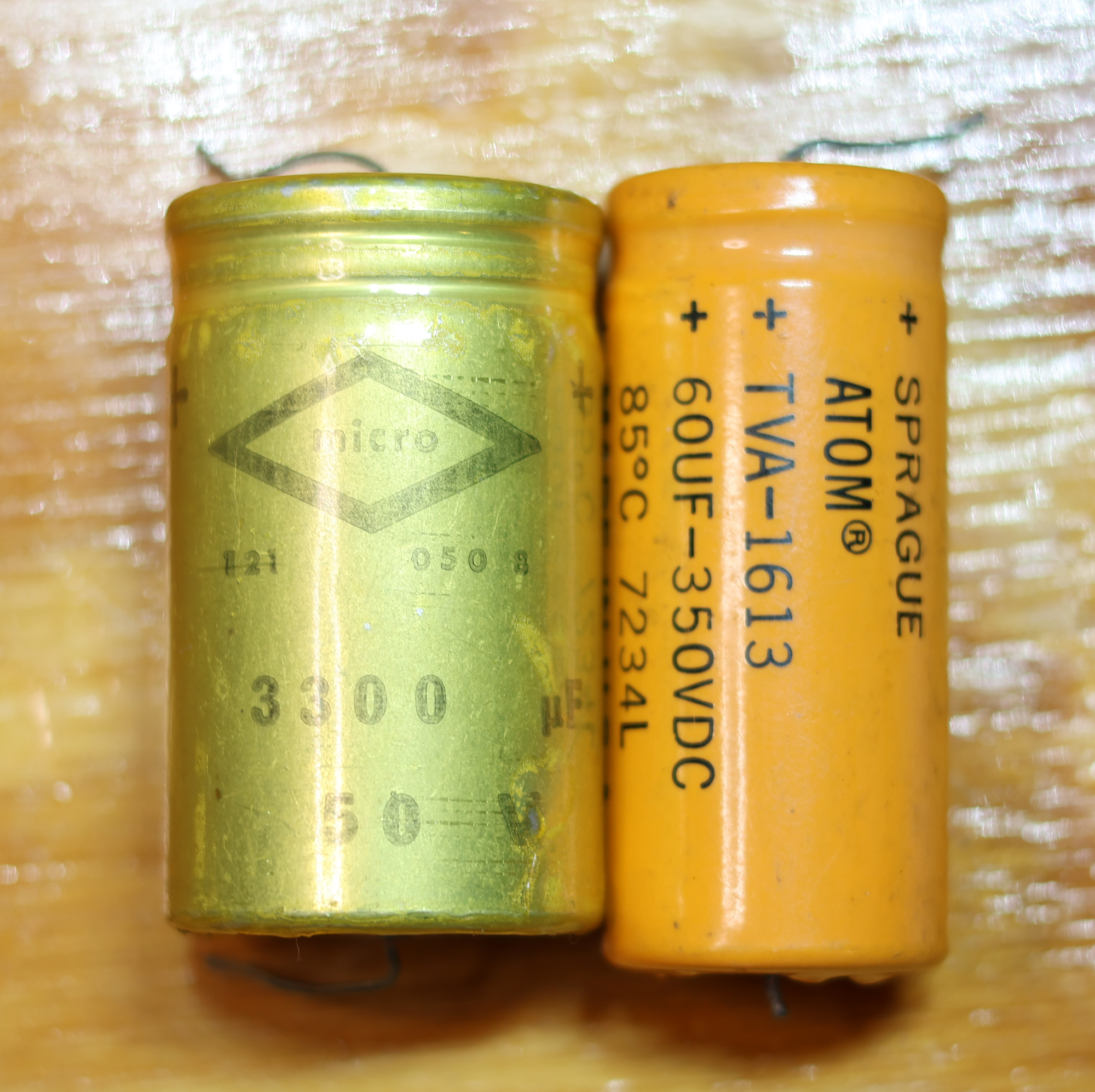
Every few months someone on a forum announces they’re going to “reform” a shoebox of NOS capacitors, and the replies split into two camps: the ones who insist it’s mandatory, and the ones who insist it’s folk medicine. Both camps are right about a subset of parts and wrong about the rest. The difference comes down to chemistry — specifically, what the dielectric in an aluminum electrolytic actually is, and what an applied voltage does to it.
The dielectric is only a few hundred nanometers thick
An aluminum electrolytic capacitor’s anode is high-purity aluminum foil, tunnel-etched to multiply its surface area by 20–100×. That foil is then anodized in a forming bath, growing an amorphous Al₂O₃ layer at roughly 1.2–1.5 nm per volt of formation voltage, which is typically 1.3–1.5× the part’s rated voltage. A 450 V capacitor therefore carries a dielectric on the order of 600–800 nm thick. That oxide is the entire capacitor.
The second foil is not really the cathode. The electrolyte is the cathode; the foil is just a current collector wetted by it. The electrolyte itself is a formulated solution — ethylene glycol with boric acid and ammonium borate for high-voltage parts (water content held under a few percent), or GBL/DMF with ammonium carboxylate salts for low-voltage types (water content 5–20%).
That water matters enormously, in both directions.
What goes wrong on the shelf
With no voltage applied, the oxide is chemically attacked by the water in the electrolyte. The dominant reaction is hydration:
Al₂O₃ + H₂O → 2 AlO(OH) (boehmite)
with further conversion toward Al(OH)₃ at defect sites. Boehmite is a much poorer dielectric than amorphous alumina — lower breakdown strength, higher ionic conductivity. There’s also slow chemical dissolution wherever the oxide was thin or stressed to begin with. Nothing repairs any of this, because repair requires an electric field.
The result is a capacitor that still measures fine on a capacitance meter and is quietly waiting to draw hundreds of times its rated leakage the moment you hit it with rated voltage. The reaction is thermally activated, roughly doubling per 10 °C, so a decade in a hot attic ages a part far faster than the datasheet’s 25 °C shelf life implies.
What reforming actually does
Reforming is nothing more than re-anodizing the foil in situ, using the capacitor’s own electrolyte as the bath:
Anode: 2 Al + 3 H₂O → Al₂O₃ + 6 H⁺ + 6 e⁻ Cathode: 6 H⁺ + 6 e⁻ → 3 H₂
Two things follow from this that explain the whole procedure.
First, it is self-targeting. Leakage current concentrates where the oxide is thinnest or most hydrated, because that’s where the field is highest — and that current is precisely what rebuilds the oxide there. Leakage decays as the weak spots thicken, which is why you watch the current rather than the clock.
Second, it makes hydrogen. Manufacturers add depolarizers — nitroaromatics such as nitroanisole or nitrobenzene derivatives — to chemically absorb H₂ before it pressurizes the can. In a part that’s been sitting for thirty years, that depolarizer may be partly spent. This is the entire argument for going slow and current-limited: a fast reform generates gas faster than the chemistry can mop it up, and the vent is the pressure relief of last resort.
There’s a hard ceiling, too. Anodization only builds oxide up to the applied voltage, and you must never exceed the original formation voltage. Push past it and you’re not repairing anything, you’re growing new dielectric, gassing hard, and heating a sealed aluminum can.
Which capacitor types this works on
Wet aluminum electrolytics — yes. This is the entire subject. High-voltage, large-can, screw-terminal, computer-grade and photoflash parts benefit most: thick oxide, lots of stored energy, and an ugly failure mode.
Non-polar / bipolar aluminum (motor-start, some crossover parts) — yes, but they’re two anodes back to back, so each polarity needs its own pass.
Wet-slug tantalum — technically yes, Ta₂O₅ re-anodizes the same way, but these are far more storage-stable and rarely need it.
Solid tantalum (MnO₂) — no. There’s no shelf-life hydration mechanism to undo. These self-heal thermally, by converting MnO₂ to insulating Mn₂O₃ at a fault. Reforming accomplishes nothing.
Polymer aluminum and polymer hybrids — no. There’s no free water to drive re-anodization, and the conductive polymer heals by localized de-doping instead. Their shelf life is essentially a non-issue.
Film, ceramic, mica, paper-in-oil — no. No anodic dielectric exists. A leaky paper coupling cap doesn’t get reformed, it gets replaced.
When to do it
Reform when the part is healthy but asleep: NOS large-can aluminum electrolytics stored more than a couple of years (manufacturers variously cite 1–5 years, and less for high-voltage types); a vintage amplifier’s original multi-section can that you want to keep original; anything where the replacement is unobtainium, potted, or a specific can profile you can’t buy. Above roughly 100 V it’s cheap insurance. Below 50 V, in gear stored a few months, it’s ceremony.
When not to
Any mechanical distress. Bulged top, popped vent, weeping electrolyte, crusted seal, tilted rubber bung, corroded terminals. Reforming cannot return lost electrolyte, and you’d be pressurizing a compromised can.
Dried-out parts. Reforming restores the dielectric, not the electrolyte. Measure first: if ESR is several times spec and capacitance is 20–30% low, the part is finished and no amount of voltage will bring it back.
Capacitor-plague-era parts (roughly 1999–2007, corrosive water-based electrolytes). Replace them.
Cheap, available, small parts. A 10 µF 25 V radial costs pennies. Your afternoon does not.
Anything reliability-critical. A successfully reformed 45-year-old capacitor has a repaired dielectric and a nearly spent service life. You fixed the leakage, not the remaining hours.
And the big one: “reforming” a whole chassis with a Variac. That isn’t reforming. That’s slowly energizing an entire circuit — including a possibly-shorted rectifier, leaky coupling caps, and a bias supply that comes up on its own schedule while your output tubes sit there unbiased. Pull the capacitors and reform them individually, on the bench, through a current limit.
The procedure, briefly
Isolate the capacitor. Use a bench supply with an adjustable current limit, or a series resistor (10 k–100 k for high-voltage work) with a DMM across it to read current by Ohm’s law. Limit to a few milliamps. Start around 10–25% of rated voltage and step up as leakage decays; a big 500 V can may want four to eight hours, or overnight. Never exceed the working voltage. Check the can’s temperature periodically — warm means back off, hissing or a sharp solvent smell means stop.
You’re done when leakage settles under the datasheet limit, commonly around I ≤ 0.01·C·V + 3 µA after five minutes at rated voltage. Then measure capacitance and ESR. If those fail, congratulations: you’ve reformed a capacitor that still needs replacing.
Charged 450 V cans are genuinely dangerous. Discharge through a resistor, verify with a meter, and keep one hand in your pocket.