
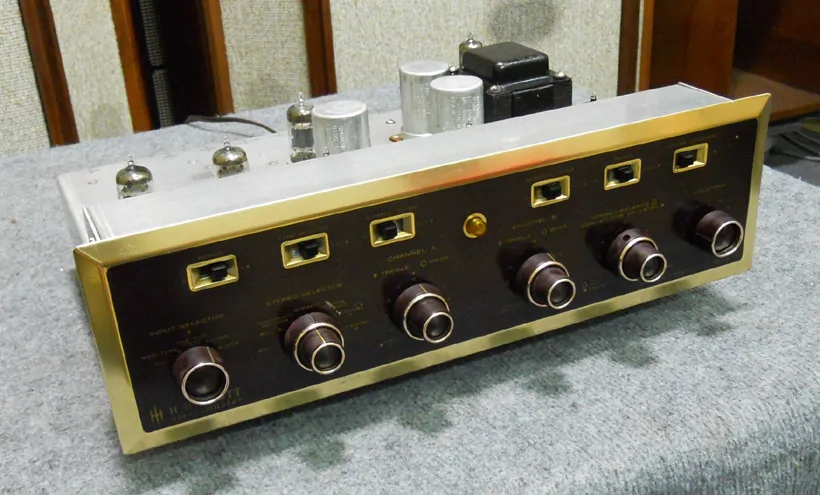
You found it. A Scott 299 under a moving blanket, a Dynaco ST-70 behind the water heater, a console radio your uncle swears “worked when we put it up there.” It smells like a basement, and one thought is running through your head: let’s plug it in and see if it lights up.
Please don’t. That’s how a $600 find becomes a $600 parts donor. The magic smoke is a one-way transaction — it leaves, it doesn’t come back, and it takes the output transformer along as a souvenir. Gear that’s slept for thirty years usually isn’t broken, just unwell. Here’s the order of operations that wakes it up without a funeral.
Rule 0: it is not a lamp
Assume the filter caps are charged. B+ caps hold a lethal charge for years, and the bleeder resistor meant to drain them is also forty years old and may have quietly retired. Discharge through a resistor — a few kilohms, a couple of watts, on an insulated probe — then confirm with a meter. Not “probably zero.” Zero.
Step 1: inspect before you electrify
Ten minutes with a flashlight beats an hour with a soldering iron.
- Rodents. Nesting material, chewed insulation, or that ammonia smell means corrosion you can’t see yet.
- The mains cord. Cracked or crumbling rubber gets replaced. Not a judgment call.
- The fuse. Right value? Vintage gear attracts creative repairs: foil, solder blobs, the occasional actual nail.
- The “death cap.” Many pre-1970 sets have a capacitor from one mains leg to chassis; when it fails, it puts line voltage on the chassis. Cut it out, fit a three-wire cord, and bond a real safety earth.
- Casualties. Bulging electrolytics, green crust on sockets, resistors gone the color of burnt toast.
Step 2: pull the tubes and let the ohmmeter talk
Pull every tube and label the sockets with masking tape — future you will not remember which 12AX7 was V3. Two reasons: the transformer is then asked to do almost nothing, and if a reading comes back wrong, no tube can take the blame. Unplugged, with the tubes out:
- Safety earth to chassis: well under an ohm, or the ground isn’t doing its job.
- Mains primary: continuity with the switch on, open with it off. Ten to a few tens of ohms is typical; fully open means a dead transformer and a very different project.
- Primary to chassis, primary to secondaries: open — megohms, ideally off the scale. Measurable leakage is a stop sign.
- Heater winding: a fraction of an ohm, isolated from chassis unless the design grounds a center tap on purpose.
- HV secondary: tens to a couple hundred ohms, both halves of a center-tapped winding close to equal. A real mismatch suggests shorted turns.
- B+ to ground at the first filter cap: the reading should climb as your meter charges the cap, then settle at the bleeder value — tens to hundreds of kilohms. A dead short, or a stubborn few hundred ohms, means a shorted filter cap or a coupling cap that’s lost its will to insulate.
While you’re in there, work every switch and pot a few dozen times. Old contacts respond well to exercise and DeoxIT.
Step 3: reform the capacitors first
A capacitor that’s napped for three decades has not come back rested. Its oxide layer has partially dissolved, and full B+ turns it into a small firework. Bring the electrolytics up slowly on a current-limited supply first — full procedure in Reforming Electrolytic Capacitors. Do that, then come back here.
Step 4: build a dim-bulb tester
Best twelve dollars in this hobby: an incandescent bulb in series with the mains feeding your device. At normal draw it barely glows and most of the line voltage reaches the gear. On a short it lights hard and drops most of the voltage across itself, capping fault current at whatever the bulb passes — so nothing inside gets the chance to become an ember.
Sizing: roughly half to equal the device’s normal draw. 40–60 W for a preamp or small radio, 100 W for an integrated, 150–200 W for a serious power amp. Too large doesn’t protect; too small and the gear never comes up to voltage. Incandescent or rough-service bulbs only — an LED does no current limiting and will sit there dark and smug while your amplifier cooks.
Reading it:
- Bright flash, fading to dim or dark — normal inrush charging the filter caps. Proceed.
- Stays bright as a searchlight — dead short. Power off, go find it.
- Steady medium glow — excessive draw. Something’s leaking. Investigate.
Two caveats: the tester limits current but doesn’t make the work safe, and while the bulb glows the device runs on reduced voltage, so every reading comes in low. Expected, not a symptom.
Step 5: first power-up, tubes still out
Dim-bulb tester in line, variac too if you have one — ramp from zero while the bulb limits fault current. Meter on the heater winding, hand on the switch.
Watch the bulb first, the meter second. Heater voltage should land near spec. With solid-state rectification B+ will be present and high — no tubes means no load, and 10–20% over the service-manual figure is normal. Let it sit ten minutes. Your nose is an instrument: warm varnish is tolerable, burning phenolic and ozone are not. A warm transformer is fine, one too hot to touch is not.
Step 6: tubes back in, one course at a time
Rectifier tube first, if it has one, so B+ rises gently instead of slamming in. Then the output tubes, then the small-signal tubes. Check bias immediately after the outputs go in — old bias supplies drift, and an unbiased output tube shows you glowing red plates inside a minute. Red plates mean off, now. Use a dummy load, or speakers you wouldn’t mourn. Not the Quads.
Step 7: off the leash
Once it’s stable, pull the bulb, bring the variac to full line, and let it idle for an hour with an eye and a nose on it. Then feed it signal — and still don’t leave it unattended for a while yet. Old gear likes to fail in the second hour, purely out of spite.
Patience costs you an evening. Impatience costs you an output transformer that hasn’t been made since Eisenhower.